
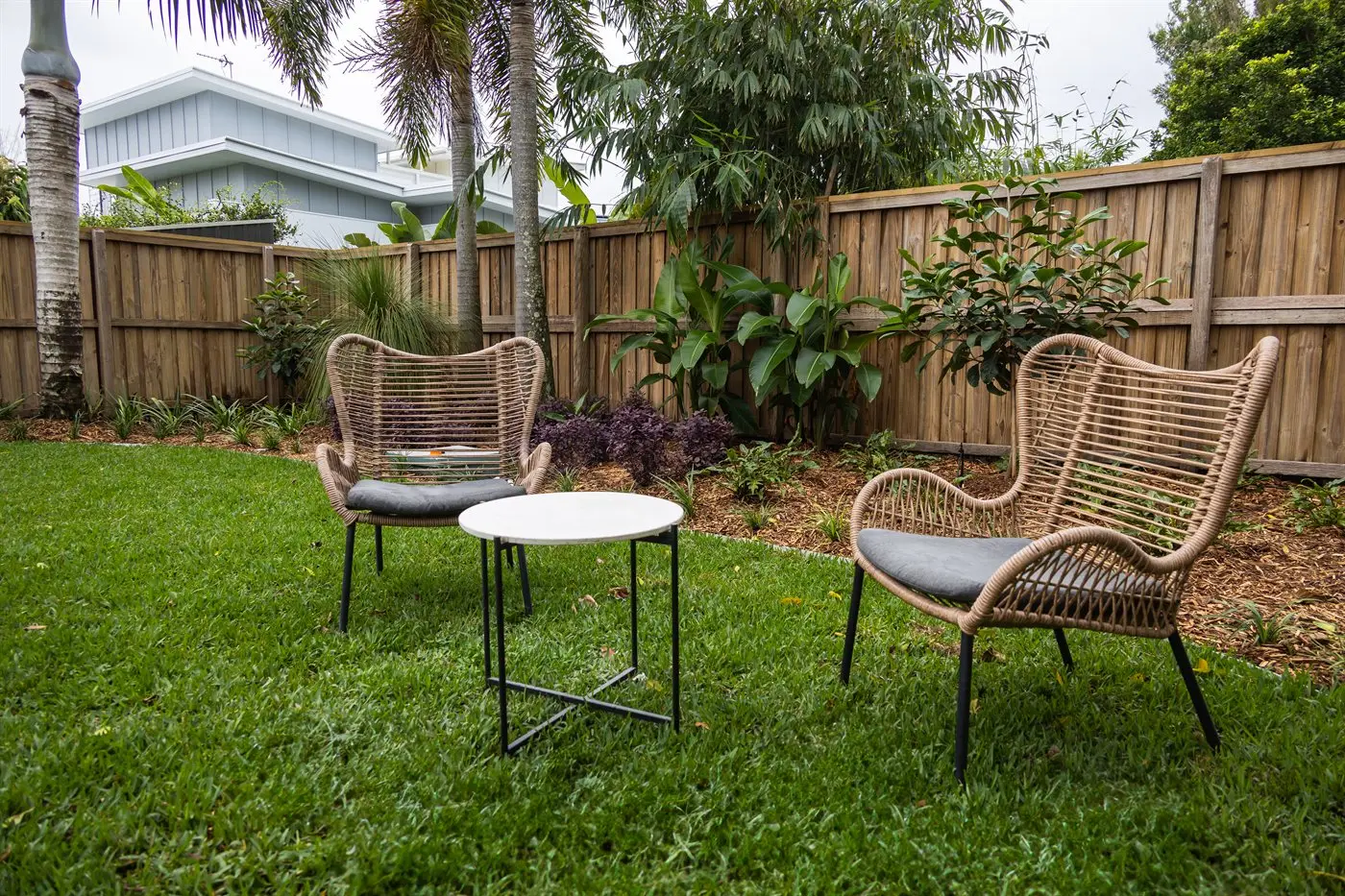
Soft landscaping
Turf laying, Sunshine Coast
Instant turf is the easy part. The ground it goes onto decides whether it holds.
Turf laying on the Sunshine Coast is where the cheapest quote and the most expensive outcome most often meet.
Instant turf looks finished the day it goes down, which is exactly why it gets used to cover problems rather than solve them. Laid over compacted clay, over a surface that falls toward the house, or over ground with no drainage, a new lawn looks immaculate for three weeks and then thins, yellows and stays wet in the same patches the old one did.
We treat turf as the final layer of a piece of groundwork rather than a product delivered to the kerb. The levels get corrected, the falls get set, drainage and irrigation go in where the site needs them, and the underlay is prepared for the variety being planted. Then the turf goes down.
What we build
Choosing the variety
Shade, wear and how much mowing you are prepared to do decide this more than appearance does. We specify against your site rather than a preference.
Soft-leaf buffalo
The dependable default for Coast lawns. Handles humidity, takes moderate shade, wears reasonably and self-repairs. Broader leaf and a faster vertical growth habit, so it needs regular mowing.
Zoysia
Finer leaf, dense mat and slower growth, so noticeably less mowing. Good shade tolerance and a soft feel underfoot. Slower to establish and slower to repair damage.
Couch
The finest finish and the best wear tolerance, which is why it is used on sports fields. Needs full sun and the highest maintenance input of the three.
Coastal and salt exposure
On beachside sites at Coolum, Marcoola and Mooloolaba, salt tolerance and very fast drainage govern the choice and the irrigation design.
Shaded sites
Under mature canopy, no turf performs indefinitely. We will recommend groundcover, planting or a hard surface rather than sell you a lawn that fails twice.
Pool surrounds
Lawn to a pool edge needs a clean transition at the coping and drainage that keeps splash-out from saturating the root zone.
What happens before the turf
Levels, drainage, underlay
Levels come first, and they are the part that cannot be corrected later. The surface has to fall away from the house and toward somewhere water can actually go. On the flat river-plain ground around Maroochydore that fall has to be constructed, because the site provides none. Getting it wrong means water sits in the lawn and against the building, and the only fix is lifting the turf and starting again.
Then the subgrade. Existing lawn, weed and any compacted crust is removed rather than rotary-hoed and buried, because buried organic matter decomposes and the surface subsides unevenly. Compacted clay needs breaking up so roots can penetrate, and on the reactive clay through Caloundra West and Little Mountain this is the difference between a lawn that establishes and one that sits in a shallow pan of water.
Drainage and irrigation go in at this stage because it is the only cheap time to do it. Subsoil lines, a spoon drain across a low point, or pop-up sprinklers all involve trenching, and trenching a finished lawn means cutting it open again. Where drainage is the underlying problem, we deal with it here rather than laying turf over it.
Underlay soil is last. A prepared, screeded layer of quality underlay gives the roots something to move into and lets us achieve a true, flat finish rather than following every undulation in the subgrade. Turf laid straight onto unimproved subsoil roots slowly, dries out fast and shows every bump. Then the turf is laid in a staggered pattern with tight joints, rolled, and watered in immediately.
Common questions
Answered
What is the best turf for the Sunshine Coast?
For most residential lawns here, a soft-leaf buffalo such as Sir Walter is the reliable default: it handles our humidity, takes moderate shade and repairs itself well. Zoysia varieties such as Empire are a good choice where you want a finer leaf and lower mowing frequency. Couch varieties give the finest finish and the best wear tolerance but need full sun and more maintenance. Shade is usually the deciding factor rather than preference.
What does turf laying cost per square metre?
The turf itself is the smaller part of the number. Preparation is the larger part: removing the existing surface, correcting levels, importing and spreading underlay soil, and installing drainage or irrigation where the site needs it. A quote that only covers turf and delivery is not comparable to one that includes the ground it is going onto.
How long before I can walk on new turf?
Keep off it as much as possible for the first two to three weeks while the roots knit into the soil below. Light foot traffic after that is fine. Full use, including children and pets, is realistic at around six weeks in the growing season, and longer if it goes down in winter.
Why does my lawn stay wet and patchy?
Almost always drainage or compaction rather than the turf variety. On the flat, low-lying ground around Maroochydore there is often nowhere for water to fall to, so it sits in the profile. On compacted clay the roots cannot get down and the surface holds water above them. Both are fixed underneath the lawn, which is why relaying turf onto an unaddressed subgrade produces the same result twice.
Do I need irrigation for a new lawn?
For establishment, new turf needs consistent water for the first few weeks, and hand watering is genuinely hard to keep up in a Queensland summer. Beyond establishment, irrigation matters most on free-draining sandy soils at Coolum, Marcoola and the beachside suburbs, where water passes through the root zone very quickly.
Will turf grow in shade?
Some will, within limits. Soft-leaf buffalo tolerates moderate shade better than couch, which really needs full sun. Under dense established canopy, such as the mature trees through Buderim, no turf will hold reliably, and the honest answer is a shade-tolerant groundcover, planting or a paved or decked surface instead of replacing failed lawn every second year.
Part of the same build
Related work
Turf is the last layer. These are the ones underneath it.
Ready to start the conversation?
Find out why your lawn is not holding
A structured site visit where we look at the levels, the soil and where the water goes, and tell you whether you need new turf or you need the ground underneath it fixed.